project-image

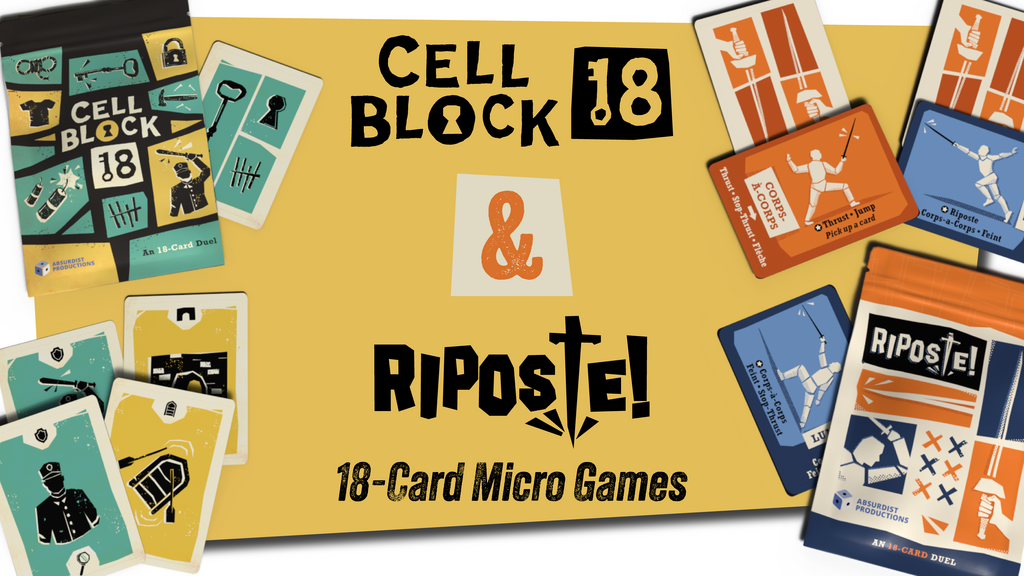
Riposte! and Cell Block 18 - Micro Card Games

Created by Absurdist Productions

It's not too late to pre-order Cell Block 18 and Riposte! The games are fully funded and currently in production. Pre-order now for delivery in February.

Latest Updates from Our Project:

Let's Talk About Other Worthy Campaigns
3 months ago – Tue, May 19, 2026 at 11:26:48 AM

Riposte! and Cell Block 18 have been funded, and we couldn't be happier. There are a lot of other cool games up as part of this Pocketopia event that we think should be funded, but haven't quite made it there yet. So we wanted to point them out to folks.

The Cure

The Cure is a portable, hidden-role co-op game for 2-4 players. However, there is a chance for a hidden traitor. We've played this one in person several times with the folks from the Baron’s Game Room, and it's a blast. It’s a fast-paced game with just a bit of paranoia.


https://www.backerkit.com/c/projects/the-baron-s-game-room/the-cure-can-you-trust-your-fellow-scientists 

Pipes - When Water Means War

This is an interesting 2-player path-building strategy game. David backed this one because of his love of pathing games and the art's Victorian aesthetic. It also looks like a deceptively simple, yet thinky, type of game, as your options on the next turn are somewhat limited by your previous play.


https://www.backerkit.com/c/projects/wotan-games/pipes-when-water-means-war

Gnome Squad

This one was backed by Will. It’s a 1-3 player tactical programming combat game where you have to choose the best gnomes for your squad and which order to place them. Power and positioning matter as they face off against your opponent’s gnomes. The art is great,


https://www.backerkit.com/c/projects/green-cloak-creative/gnome-squad

Kill the King

This is another hidden role game. Your goal is simple: either identify and kill the King, or if you are the King, stay hidden and survive. The game has some beautiful art, and it's so close to funding.


Funded!
3 months ago – Mon, May 18, 2026 at 08:30:21 AM

The Campaign for Cell Block 18 and Riposte! is officially funded!

Thank you, all of our backers. 

You are the reason we can bring this project to life.

Something weird with our last email
3 months ago – Fri, May 15, 2026 at 12:38:12 PM

I just posted an update with some background about the design of Cell Block 18. If you got the email that went along with it, you probably noticed the... uh... technical problem.

I'm not exactly sure what happened with that, but I'll be checking with BackerKit to see if that was our mistake or theirs.

Anyway, you can read the full update on BackerKit.

Thanks,
Will

Designing Cell Block 18
3 months ago – Fri, May 15, 2026 at 12:08:05 PM

The Mechanics

Cell Block 18 was loosely inspired by the old jailbreak movies of the 60s and 70s. Think The Escape from Alcatraz (1979)  with Clint Eastwood.


With that in mind, I knew from the start I wanted the game to be asymmetric, and since I was limiting myself to 18 cards, I decided it made sense to go with only 2 players.

Since prisoners work in secret to plan and execute their escapes, I decided the Prisoner would play their cards face-down. Meanwhile, the Warden's actions are face-up and much more reactive, as they essentially defend against the Prisoner and try to stop their escape. The prison is depicted via three rows in the center of the table, with the players playing their cards to the rows as they work against each other.

The prisoner also has more cards at the start of the game, 8 versus the Warden’s 5, but the Warden has more options in how they play and move their cards compared to the Prisoner, who primarily just plays a single card face down each turn.

The Theme

As I mentioned, the game was in part inspired by old movies, so for the Prisoner cards, I tried to distill the essence of those movies. The Prisoner is trying to get a set consisting of clothes, tools, and one of three escape methods: Rope, Raft, or Tunnel. Mimicking the most common methods you see in old films.

For the Warden, I started with the two guard cards, giving them the ability to either search or block card play, which I felt fit the role of guards. The guards can also move about the prison, giving the Warden some flexibility. Then I thought about how a prison might secure itself against the three escape methods I had chosen. Thus, I devised the reinforced walls to stop the tunnel, underwater spikes to pop the raft, and razor wire to prevent using the rope to climb the walls. Naturally, these improvements to the prison can’t move, so they only limit escape using those methods from specific rows of the prison.

The Art
Going back to the themes that inspired the game, I really loved the sort of cutout pop art that was used on the covers of some mid-century pulp novels and in the front credits of some crime and spy movies of the 60s. A. Giroux translated that style amazingly to Cellblock 18. Creating these beautiful and unique looks for each card.

Another aspect of the art design was the iconography. I really wanted this game to be essentially language independent. No text on the cards. Between the clear icons and clean layout, she really knocked it out of the park. Once you know how to play, the game plays quickly and easily without having to read anything.


Thanks,
David

Designing Riposte!
3 months ago – Wed, May 13, 2026 at 02:42:38 PM

For this update, I just wanted to give some background information on Riposte!

The Mechanics

When I began this, I knew I was making a sword-fighting game, but the earliest cards were just labeled "A, B, C, D, etc." I wanted to start with the mechanisms before tying the cards to actual moves. From my first concept, I knew I wanted something fully symmetrical with simultaneous play, where each move limited your next.

When I began this, I knew I was making a sword-fighting game, but the earliest cards were just labeled "A, B, C, D, etc." I wanted to start with the mechanisms before tying the cards to actual moves. From my first concept, I knew I wanted something fully symmetrical, with simultaneous play, where each move limited your next.

I worked out which cards could "follow" others and which cards could score a hit on which others. This took some fenangaling, and a few rules:

  1.  No two cards can score on each other.
  2. The cards that follow any given card cannot score on the same cards.
  3. No two cards can have the same "follows."
  4. No two cards can have the same "hits."
  5. Each card needs to appear an equal number of times in both "hits" and "follows."
  6. Nothing scores against Parry, and Parry scores against nothing.

I never found a formula to simplify this process, but I did build a spreadsheet that validated each rule. After a lot of brute-force rearranging, I got everything roughly aligned. At this point, the base mechanics worked and had the potential to be fun. From there, it was a matter of playtesting, realizing I'd made a mistake, and doing it again. This was surprisingly more difficult than I had imagined, but I eventually got it right.

I tried a few different numbers of "hits" and "follows" listed and settled on each card "hitting" two others and having three cards that can follow it. The math just worked out, and it was fun to play. For a while, I also toyed with special effects on the cards, but I cut them out (leaving only Parry) when I realized they were becoming too difficult for players to manage on top of the base gameplay.

The Theme

After getting a functional version of the game, I started trying to tie the generic cards to different "moves." I'm not a fencer, so I had to do some research while designing Riposte! I looked at both modern fencing and historical swordplay to develop the moves listed on the cards. The final list ended up being:
  • Lunge
  • Thrust
  • Stop-Thrust
  • Flèche
  • Riposte
  • Feint
  • Corpse-a-Corpse
  • Jump
  • Parry

From what I can tell, modern fencing doesn't really break maneuvers down in this way, but much of this terminology remains in the vocabulary. I wanted words that were distinct from one another, had a chance of scoring, and could be represented well in art.

The Art

In our first meeting with A. Giroux, we discussed Riposte! having a style reminiscent of 18th-century fencing manuals, while Cell Block 18 would have sort of a mid-century mystery novel vibe. After seeing samples in both styles, we loved the more modern look for Riposte!


It wasn't until we started working on the art that we got the idea to have the cards mirrored so the fencers face one another. In retrospect, this seems obvious. In retrospect, it seems obvious. The sideways layout game later as well. In early tests, some players mixed up which cards a move "hits" and which ones can follow it. We put the following cards on the bottom so they are oriented up while the card is in your hand. The "hits" are on the side, so they are ready parallel to the fencer. This means you form a map of the bout as you play cards one after another.

Personally, I think Alisha's art looks fantastic on these cards. The colors are clear, the poses are distinct, and the graphic design is very user-friendly.


That's all for now. We'll talk about Cell Block 18 in the next update.

Thanks again for your support!

Will